

Two things separate a trustworthy pokies forum from a dangerous one. They are moderation that applies the same rules to everyone, and transparency about who runs the place and why. These matter far more than how busy it looks or how friendly the welcome message reads. A forum can have thousands of posts a day and still be a bad place to trust with your experience or your account details. A forum can be small and quiet and still be honest. The signals that tell you which one you are looking at are concrete, and you can check most of them in an afternoon of reading before you ever post.
If you have not yet confirmed the community is alive at all, start with our breakdown of active gambling communities, because a dead forum’s moderation standards do not matter. If you are still deciding what kind of venue suits you, our guide to player communities and forums on popular online gambling sites covers that ground. Here, I am assuming you have found a place and want to know whether it deserves your trust.
What Good Moderation Actually Looks Like
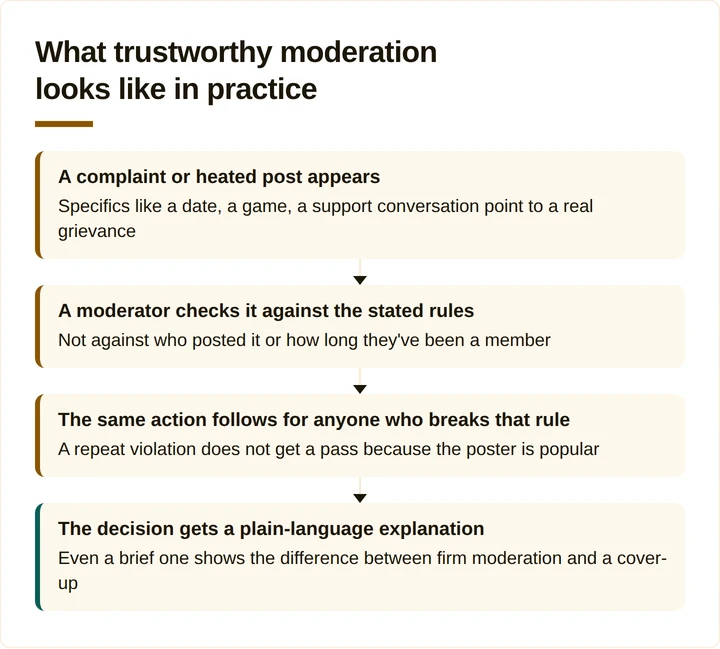
Good moderation is consistent before it is anything else. The same rule that gets a new member’s thread locked gets a long-standing member’s thread locked too. That sounds obvious, and it is the single hardest thing for a forum to actually do, because the temptation to protect familiar voices is constant.
Watch how a forum handles a complaint. A frustrated player with a real grievance and someone deliberately spreading misinformation can look similar in a single angry post, and a moderator’s job is to tell them apart. The frustrated player usually has specifics. Look for a date, a game, a support conversation, a sequence of events. The misinformation spreader usually has a dramatic claim and no detail, or a claim that conveniently promotes something. A forum whose moderators make that distinction well will let the frustrated player vent and ask follow-up questions, while quietly removing the person who is just stirring.
Escalation matters too. Trustworthy forums have a predictable way of handling repeat or serious violations, even if that process is not publicly logged. What matters is visible consistency: warnings that lead somewhere, bans that are not arbitrary, and members who break the same rule twice facing real consequences instead of being excused because they are popular.
A moderator who explains a decision in plain language, even briefly, is doing the job well. A moderator who deletes first and never explains is not necessarily corrupt, but you have no way to tell the difference between firm moderation and cover-up. When I read a forum’s older threads, I look for at least one moment where a moderator said why something was removed. That single habit tells you more than any rules page.
What Real Transparency Looks Like
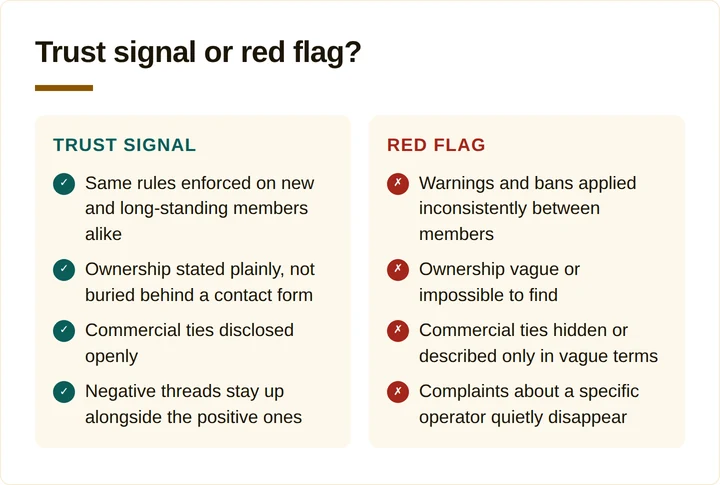
Real transparency starts with a plain answer to a plain question. Who runs this place? A forum that states this clearly, in its own words, on a page you can find without hunting, is already ahead of most. A forum that buries ownership behind a generic contact form and a privacy policy written by a template is telling you something too.
The second question is whether there is a commercial relationship with a casino or operator, and whether the forum says so. Advertising and affiliate revenue are common among gaming communities, and plenty of them still moderate honestly. What matters is disclosure. If the people running the place have an incentive to hide bad news about a particular operator, and they have not told you about that incentive, you cannot judge their moderation fairly, because you do not know what they are protecting.
Independence is worth more when you are discussing a bad experience. A forum independent of any casino operator has less reason to delete or bury a thread about a withdrawal that went wrong. A forum run by or for a specific operator has an obvious reason to do exactly that, and you must assume this pressure shapes their moderation regardless of what you observe. That uncertainty is the cost. When I am weighing whether to trust a forum with a genuine complaint, this is the factor I weigh heaviest.
There is a third layer, quieter than the first two. Does the forum talk about risk at all? A community that only ever discusses wins is not transparent, it is promotional. A community where people openly discuss losing streaks, deposit limits, and taking breaks is one where the moderation is probably not shaping the conversation toward a sale.
Red Flags: When to Back Out
Any one of these on its own is worth a second look. Two or more together, and you should leave.
Negative threads keep disappearing. Completely removed. Threads vanish entirely, unlike locked posts or relocated discussions. If you can find a pattern where complaints about a particular operator or a particular experience vanish while praise stays up, that is the clearest signal a forum’s moderation serves someone other than its members.
The promotional content has no counterweight. Every thread reads like an advert, and nobody ever posts about a bad session, a slow withdrawal, or a game that felt off. Genuine communities show friction—disagreements, complaints, mixed experiences. A forum where everything is positive is either heavily curated by someone protecting someone else’s interests, or barely populated by real people, and either way it is not a place to trust.
Commercial ties are hidden or vague. The forum takes money from somewhere, and you cannot work out from where. “We partner with leading brands” tells you nothing. If a forum will not say plainly who pays for it, assume the answer is someone whose interests are not yours.
Rules are enforced inconsistently between members. The same behaviour gets a warning for one person and a ban for another, or a rule that is quoted at new members is quietly ignored for regulars. This is the moderation failure that is hardest to spot from a single visit, which is why reading old threads matters. Look for a moment where two similar posts got very different treatment.
Dramatic claims go unchallenged. Guaranteed wins, inside information, a system that beats the machines. A forum that lets these stand without anyone pushing back is either unmoderated or moderated by people who benefit from them. Either way, do not act on anything you read there.

A Quick Way to Check Before You Post Anything Personal
Before you type account details, a screenshot of a balance, or anything else personal into a forum, even one that looks trustworthy, run this short check.
First, confirm the site uses HTTPS. Do not share account information over an unencrypted connection under any circumstances. Second, do not overshare. A forum does not need your account number, your full name, or a screenshot showing your balance to help you with a question. Post the minimum needed to explain the situation. Trust is built over time, and no forum has earned enough of it on day one for you to hand over financial details.
Third, treat dramatic claims as things to verify elsewhere before acting on them. If someone posts that a particular game is paying out unusually well, or that they have a method, check that against a source outside the forum before you spend anything on it. A trustworthy community will not mind you doing this. A community that pressures you to act fast is telling you what it is.
Fourth, look at how the forum treats people who ask basic questions. If a newcomer asking something reasonable gets mocked or ignored, the moderation is not doing its job, and the community culture has drifted somewhere you probably do not want to be.
Before You Even Get Here
If you have not yet confirmed the community is alive, meaning recent posts, responses that come at a reasonable pace, and more than one regular voice, go read active gambling communities first. A forum with no current activity cannot have trustworthy moderation, because there is nothing to moderate. And if you are still working out where communities actually live, whether that is in-site chat, a standalone forum, or somewhere else entirely, our guide to player communities and forums lays out the venue types. This article picks up once you have a specific place in front of you.
The Point of All This
Kapwa, the Filipino idea that another person’s wellbeing is bound up with your own, is a simple test for a forum. Does this place treat the people in it as people whose experience matters, or as traffic to be pointed at a link? A forum that applies its rules evenly, says plainly who runs it, and lets bad experiences sit in the open alongside good ones is passing that test. A forum that hides its owners, buries its complaints, and lets dramatic claims stand is failing it, no matter how polished it looks.
You do not need to be an expert to tell the difference. You need to read before you post, check who is paying for the place, and walk away when the answers do not add up. That is the whole method, and it works on any community you will ever join.
FAQ
How can I tell if a forum’s moderation is fair? Look for consistency. The same rule should apply to new members and long-standing ones. Read older threads and check whether similar posts got similar treatment, and whether moderators ever explain a removal in plain language.
Does a forum need a public moderation log to be trustworthy? No. A predictable escalation process matters more than a public one. You need to see that warnings lead somewhere and that bans are not arbitrary, not that every decision is published.
Is a forum with casino advertising automatically untrustworthy? Not automatically. What matters is disclosure. If the forum states plainly that it takes advertising or affiliate revenue, you can judge its moderation with that in mind. Hidden commercial ties are the real problem.
Why does independence from casino operators matter? A forum independent of any operator has less incentive to delete or bury discussion of a bad experience. A forum run by or for a specific operator has an obvious reason to suppress bad news, and you can never be fully sure it resisted.
What should I do if I spot a red flag? Leave, or at minimum stop posting personal information there. One red flag is worth a second look. Two or more together, especially disappearing negative threads plus hidden commercial ties, mean the forum is not looking out for you.
Can I trust a small forum with fewer members? Yes. Size is not the signal. Consistency of moderation and honesty about who runs the place are the signals, and a small forum can do both better than a large one.
Marisol Panganiban Community Editor, PinoyLucks88