

A community is active when people posted in it this week and got replies.
I’ve been part of enough online groups to know the feeling of landing somewhere that looks busy and then realising the last real conversation happened months ago. The member count still sits there, proud and useless. Nobody’s home. For anyone in our community trying to find a place to talk pokies, sports, or cards without getting shouted at, spotting which communities are actually alive matters.
What “Active” Actually Looks Like
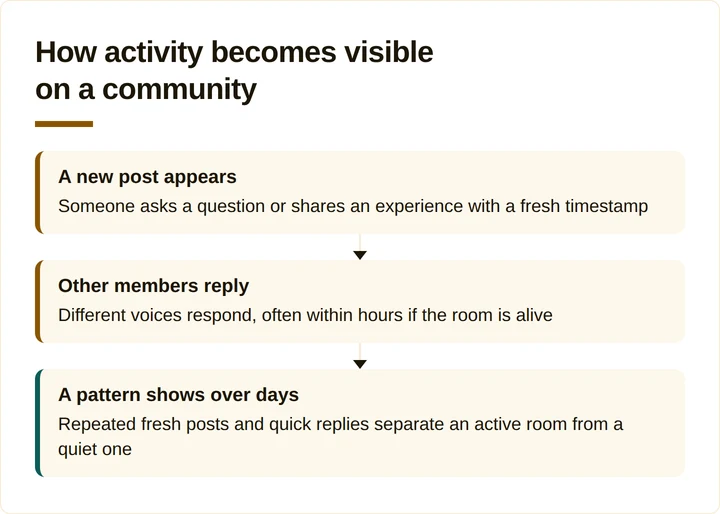
Fresh posts are the first signal. If the newest thread on the front page is from today or yesterday, someone is still showing up. If the newest thread is from last year, the community is a museum.
Scrolling a front page tells you a lot in a few seconds. A live room shows a run of posts with different dates on them, each one picking up a few replies, and the newest ones still warm. A stale room shows the opposite pattern. The top posts are old, the replies underneath them are older, and the few new posts that do appear sit untouched while the pinned welcome message from years ago keeps pride of place at the top.
Response speed matters just as much. A post that gets three replies within a few hours is a community where people are watching. A post that sits for two weeks with nothing under it tells you the audience moved on, even if the join button still works.
More than one regular voice is the third signal, and it’s the one people miss. A forum where the same person posts daily and nobody answers is a diary with a comment box. You want to see different names, different opinions, people disagreeing with each other in a way that suggests they actually read the post.
Subscriber counts don’t tell you any of this. A group can hold onto a large number long after the last real exchange, because leaving takes effort and nobody bothers. Timestamps show the reality; counts are just decoration.

Three Reddit Communities Worth Checking
Reddit isn’t the only place these conversations happen, and it isn’t right for everyone. But it’s public, which means you can check whether a place is alive before you invest any time in it.
Three long-running subreddits come up again and again when people talk about gambling communities, and each has a different character.
r/sportsbook is built around sports-betting discussion. If your interest is match analysis, line movement, or just following how a big game played out from a betting angle, that’s the room. The conversation moves with the sporting calendar, so quiet periods and loud periods are normal and expected.
r/gambling is the general room. Pokies, table games, casino talk, the odd story about a session that went sideways. It’s broader and messier than the specialist subs, which is both the appeal and the drawback. You’ll find useful threads next to low-effort ones, and the mix shifts depending on the day.
r/poker is strategy-focused. Hand analysis, table reads, decision-making under pressure. It’s the most technical of the three, and the culture reflects that. If you post a hand without explaining your reasoning, expect to be asked for it.
The current traffic at any of these changes week to week, so checking for yourself matters more than any number I could give you. Open the subreddit. Sort by new. Look at the timestamps on the first ten posts. Then open two or three of them and look at when the replies landed. That’s a two-minute check, and it shows you more than numbers can.
Each room ages differently:
- r/sportsbook: Looks almost empty during quiet stretches because its rhythm follows the sporting calendar, then fills up again when a big weekend arrives.
- r/gambling: Keeps a steadier trickle of new threads going, making it easier to see at a glance whether the room is still breathing.
- r/poker: Sits quieter between sessions but answers quickly when a hand gets posted with real reasoning attached.
A Simple Way to Rate What You’re Looking At
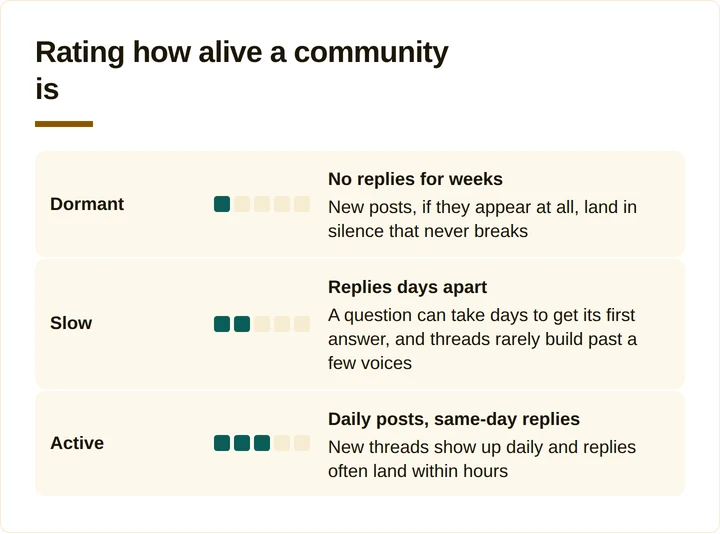
Once you’ve done the timestamp check a few times, you start to sort communities into rough bands without really trying. It helps to name them, because the difference between a slow room and a dead one is easy to blur when you’re keen to find somewhere to talk.
At the bottom is a dormant community. No replies for weeks. New posts, if they appear at all, land in a silence that never breaks. The room still exists, the rules are still pinned, and the last real exchange is old enough that you’d have to scroll to find it. Nothing here is going to answer you.
In the middle is a slow community. Replies do come, but they arrive days apart. A question posted on Monday might get its first answer on Thursday, and the thread never really builds past two or three voices. A slow room isn’t dead, and it can still be worth reading, but you should go in knowing that a conversation there moves at its own pace and might not move at all.
At the top is an active community. New posts show up daily, and replies land the same day, often within hours. Threads grow past the first exchange, people come back to add something they thought of later, and the front page looks different each time you visit. That’s the room where a question gets answered while you’re still around to read the answer.
The useful part of this scale is that it’s yours to apply. You don’t need anyone’s numbers or anyone’s recommendation. You look at the dates, you look at the gaps between a post and its replies, and you place the room on the scale yourself. A community that was active last month can drift down to slow, and a slow one can wake up when something big happens in the world it covers. The check stays the same either way, and it stays honest.
A Word on Responsible Play in These Spaces
Active communities are also where the harder conversations show up first. When someone starts chasing losses, the people around them often notice before anyone else does, because the posts change tone. If you’re the one posting, a community that responds to those moments with honesty is a better room to be in. If you’re reading, you’ll sometimes see a stranger heading somewhere bad, and you don’t have to be a counsellor to say something plain and kind.
We’ve written the full framework for keeping play within limits elsewhere on the site. You’ll find it at playing within your limits. This article’s job is to help you find a room that’s actually alive before you spend your time in it.
Checking Before You Post Basics on Every Community
Liveliness is one question. Trustworthiness is a different one. A busy forum can still be a badly moderated one, and a quiet forum can be a careful one.
The signals for judging moderation, transparency, and the red flags that should make you back out are covered in full at moderation, trust, and transparency. That’s the page to read if you’re deciding whether a specific community deserves your participation.
What kinds of community exist, and where each type tends to live, shapes your options. In-site chat, standalone forums, Reddit, Discord, comment sections on review sites—each has a different feel and a different failure mode. We’ve mapped that out at player communities and forums on popular online gambling sites, and it’s the better starting point if you haven’t yet decided where you want to spend your time.
What I’d add here is just this: check the room is alive before you check whether it’s good. There’s no point auditing the moderation of a place where nobody has posted since last winter.
In practice, that check looks like opening the community and reading down the page the way you’d read a noticeboard in a hallway. You’re not studying it, you’re just noticing whether the paper is fresh or yellowed. If the newest thing on the board went up this week and someone has written back under it, the room is in use. If everything you can see is dated and unanswered, you already have your answer, and you can move on without spending another minute on it.
Where This Leaves Us
The habit worth building is simple. Before you join anything, look at when people last talked to each other there. Focus on whether a real exchange happened this week, not membership numbers or front page polish.
That’s consistent with how we try to run things here. Kapwa, the idea that another person’s wellbeing is bound up with your own, applies to online rooms as much as anywhere else. A community that’s actually alive is one where someone will notice if you go quiet, and where a bad week gets met with something better than encouragement to keep going. You can’t get that from a member count. You can only get it from people who are still showing up.
— Marisol Panganiban, Community Editor
FAQ
How do I tell if a community is dead?
Look at the newest posts. If the most recent thread is months old, or if new posts sit with no replies for weeks, the community is dormant regardless of membership numbers.
Does a big member count mean anything?
Not much on its own. People rarely bother leaving a group, so the number stays high long after the conversation stops. Timestamps and reply activity are the honest signals.
Why does response speed matter more than post volume?
Because it tells you people are watching. A community where a new post gets a few replies within hours is one where members are present. A community with lots of old posts and no replies to anything recent is an archive, not a conversation.
Are the subreddits you mentioned still active?
They’re long-running and well known. Sort by new and check the timestamps yourself. It takes two minutes and it’s always current.
What’s the single fastest check?
Sort by new, look at the date on the top post, then open it and see when the replies arrived. If the post is from this week and the replies came the same day, you’ve found a live room.
What if a community is active but feels hostile?
A busy room can still be a bad one. That’s the moderation and trust question, and it’s worth reading up on before you commit your time.