

When people talk about “player communities and forums” in online gambling, they mean the spaces where players actually talk to each other. These are places to swap practical tips, compare real payout experiences, and find company during the ups and downs of playing. It covers where those conversations happen, why players bother joining them, and what to look for before trusting one. I’m Marisol from the Kapwa Circle board, and I’ve spent a good while reading through these spaces to understand what makes one worth your time.
Where These Communities Actually Live
Player discussion about online gambling is scattered across five recognizable venue types, each with its own character and rhythm. Knowing which is which helps you find the kind of conversation you’re actually after.
In-site chat and forums are built directly into a casino or affiliate platform. You’ll find them tucked into a corner of the site, often with a live feed of players talking while they play. These are convenient because you’re already there, and the operator also controls the space. That cuts both ways.
Standalone dedicated forums exist purely for gambling talk. These are the old-school message boards, organized into threads about slots, table games, sports betting, and the rest. They’ve been around for decades and tend to attract a mix of seasoned players and newcomers asking basic questions.
Reddit threads function as open discussion spaces without a single operator behind them. Gambling-focused subreddits work like any other corner of Reddit. Upvotes push good advice to the top, and the community self-moderates to a degree. The anonymity can make people candid in ways they wouldn’t be on a site tied to an operator.
Community-run Discord servers have grown a lot in recent years. These are real-time chat spaces built by players themselves, often around a specific game, streamer, or shared interest. The pace is fast, and the vibe often feels like hanging out with friends who happen to share a hobby.
Review-site comment sections sit under casino reviews and news articles. They’re usually shorter and more transactional. Someone asking whether a payout came through, or warning others about a slow support team. There’s rarely much depth to it, and the most current complaints and praise often land here first.
| Venue Type | What It’s Good For | Rough Vibe |
| In-site chat/forum | Quick questions while playing | Casual, operator-moderated |
| Standalone forums | Deep dives, long histories | Structured, slower pace |
| Reddit threads | Candid opinions, crowdsourced checks | Fast, upvote-driven |
| Discord servers | Real-time chat, community feel | Lively, informal |
| Review-site comments | Recent complaints and praise | Transactional, brief |
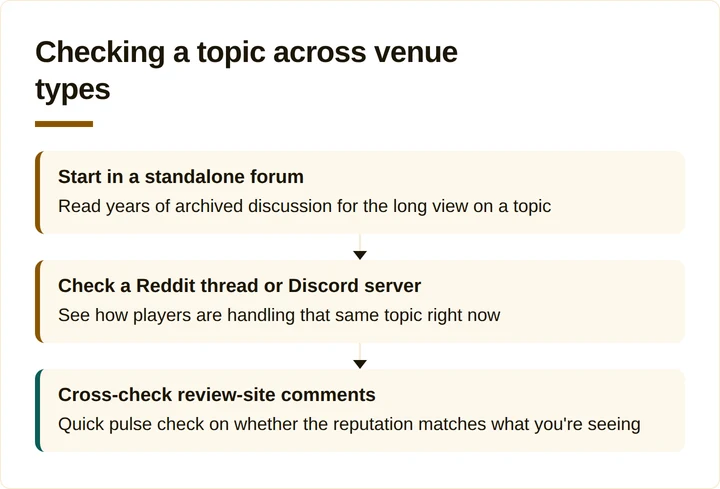
The five venue types work best together as a layered system. A reader might start with a standalone forum to read through years of archived discussion on a specific game mechanic, then jump into a Reddit thread or Discord server to see how players are handling that same topic right now. The forum gives you the long view, the kind of accumulated knowledge that takes time to build. The live chat gives you the temperature right now, including which strategies have fallen out of favor and which new ones are gaining traction. Review-site comments can then serve as a quick pulse check on whether a venue’s reputation matches what you are seeing firsthand. Used together, these sources fill in each other’s gaps, so you are never relying on a single snapshot of a community that may have shifted since that last post went up.

Why Players Bother With Them
The reasons players join these communities are pretty consistent, and they have little to do with marketing. Three things keep pulling people back.
Practical tips top the list. A bonus might look great in the promo email. How did it actually play out for someone who claimed it last week? Withdrawal timing gets discussed constantly. Players compare what really happened when someone actually hit cashout, with the kind of specific detail an operator would never publish. I’ve read threads where players compare notes on which payment methods landed fastest. Some of these niche topics get surprisingly technical. Players who prefer paying with digital currency, for instance, will swap notes on which crypto-friendly operators handle it smoothly, and that kind of comparison shows up in the crypto casino shortlist conversations that pop up across forums.
Real experiences also beat marketing copy. When you’re trying to judge whether a site treats its players fairly, a dozen forum posts from people describing their actual support chats and payout waits tell you more than any “trusted and secure” badge on the homepage. Communities aggregate those experiences in a way that’s hard to get anywhere else.
There’s the companionship, too. Gambling can be a solitary activity, especially online. Sitting in a chat during a long session, celebrating someone’s big win or commiserating over a cold streak, makes the experience feel less isolated. That social thread runs through every venue type.
A Few Signals Before You Trust One
Not every community is worth your time, and a few quick checks will save you from the bad ones.
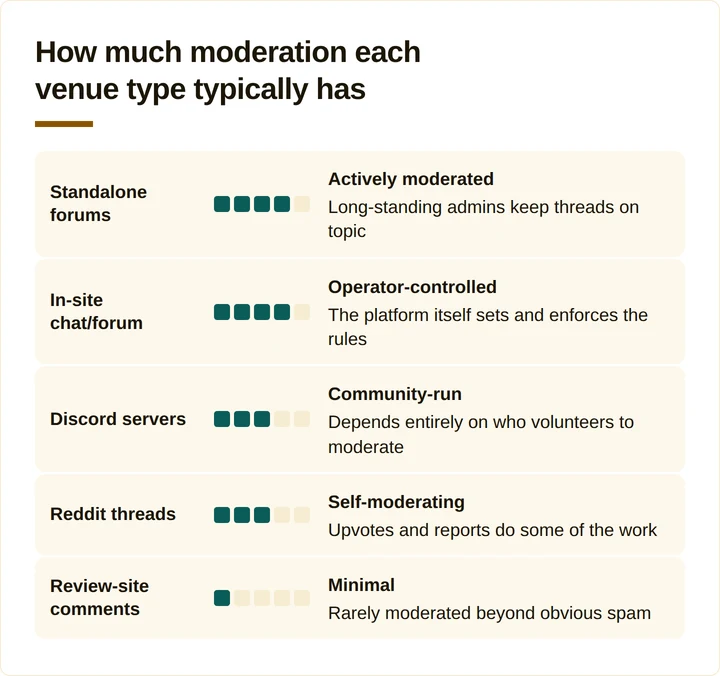
Look for active moderation. Someone is actually removing spam and keeping conversations civil. Check whether the space has a mix of praise and complaints. A forum where every post gushes about how every casino pays out instantly and every bonus is generous probably isn’t real. And see if there are clear rules about self-promotion and referral links, because those turn into spam fast.
For the deeper dive on how moderation builds trust, our moderation and transparency piece walks through the full framework.
The simplest first move is to hold off on posting entirely. Spend a few days reading through the recent threads or scrolling the chat history, just watching how people talk to each other. Pay attention to what happens when a newcomer asks a basic question. Do regulars answer with patience and a few helpful links, or do they respond with snark and a link to a search page? That small exchange tells you more about a community’s character than any welcome message ever will. If the regulars treat a beginner’s confusion as a normal part of joining, that is a good sign you can learn here without walking on eggshells. If the tone feels cold or cliquey, you have saved yourself the trouble of investing time in a space that will not give much back. Lurking counts as research, and it is the cheapest kind you will ever do.
What This Looks Like for NZ’s Filipino Players
The kapwa lens shapes this. Kapwa is the Filipino idea that another person’s wellbeing is bound up with your own. It means each person’s wellbeing is tied up with everyone else’s. That instinct shapes how many Filipino players approach these communities.
We value a forum mainly for whether it looks out for its members. A community that flags risky behaviour, warns newcomers about operators with bad payout records, and celebrates wins without encouraging chasing losses. That’s one worth being part of. A community that just amplifies hype and referral links? That’s looking out for no one but itself.
This isn’t gatekept to Filipino readers, of course. The lens is just that, a way of seeing. Anyone who brings that same care to how they participate will find good company in the right spaces. And when conversations get heated, especially around chasing losses, our playing within your limits page is there for anyone who needs it.
Conclusion
Player communities and forums are simply where the human side of online gambling lives. They’re places to learn from others’ real experiences, find company during the solitary moments, and, at their best, look out for one another. The venue types vary, from in-site chat to Discord servers, but the underlying value stays the same. Find a space with active moderation, honest conversation, and people who care about each other, and you’ve found something worth keeping. That’s the kapwa way of looking at it, and it serves anyone well.
FAQ
Are player communities and forums the same thing as social media groups? No. Social media groups can host gambling discussion, but the dedicated venues, forums, subreddits, Discord servers, are structured specifically for ongoing conversation about playing. They tend to have more history and better organisation than a general social media group.
Is it safe to share my experiences in these communities? Generally yes, if you keep personal details private. Most people use usernames and avoid sharing identifying information. The main risk usually comes from referral spam and astroturfing, which is why checking for active moderation matters.
How do I know if a community is being paid to promote a casino? Look for transparency about affiliate relationships and watch for patterns where certain operators are always praised while complaints about them get buried. A healthy community allows criticism. If every negative post disappears, something’s off.
Can these communities help me find better bonuses? They can help you understand how bonuses actually work in practice, which is often different from the marketing. Players share real experiences with wagering requirements and withdrawal conditions. That’s more useful than any promo listing.
Do I need to be an experienced player to join? Not at all. Most communities welcome newcomers asking basic questions. The key is finding a space with patient regulars and clear rules. A good community will answer the same beginner questions without making people feel stupid for asking.
What should I do if I see someone in a community struggling with their gambling? If the space has moderators, flag it to them. Many communities have guidelines about responding to signs of distress. You can also gently point the person toward responsible gambling resources. Looking out for each other is what makes a community worth belonging to.