

A casino’s reputation is built or broken largely by what players say about it in forums. Marketing copy can promise anything. Forum talk shows what actually happened when real people tried to withdraw winnings, contacted support, or chased a bonus that didn’t behave as advertised. I’m Marisol from the Kapwa Circle board, and I’ve spent years reading these threads as part of running this community. The patterns are remarkably consistent. Read that talk as a reputation check before you hand over any money.

What Forum Talk Actually Tells You
When players gather online and share experiences, they produce something no casino’s “About Us” page can match. It is an independent record of how the place treats its customers. What players write about payout speed, how support handled a dispute, and whether a promised bonus paid out as described functions as a real-world signal that runs independently of the operator’s own marketing.
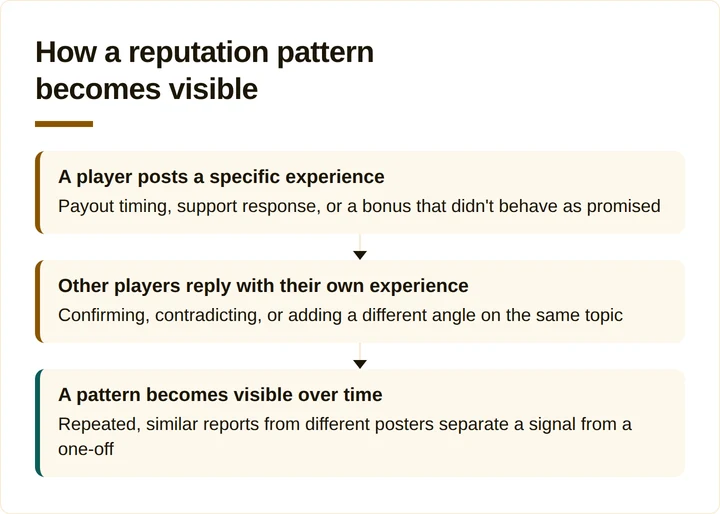
I remember reading a thread where someone described waiting far longer for a withdrawal than the site’s own FAQ had promised. Another player chimed in with a similar story from the previous month. Then a third. That’s not a coincidence. That’s a pattern becoming visible.
The key difference between marketing and forum talk is accountability. A casino’s website describes what it wants you to believe. Forums record what players experienced, often with dates, screenshots, and follow-ups. When a complaint gets resolved publicly, you can see how the operator handles problems. When complaints pile up unanswered, that tells you something too.
Payout speed matters most in these discussions, but support responsiveness runs a close second. A player who got a straight answer from support within an hour will often say so. A player who waited three days for a canned response will say that even louder.
Certain categories of complaint come up again and again across forums, and knowing them helps you know what to look for. Bonus terms, withdrawal limits, and verification delays account for most of them:
- Bonus terms not matching the ad. A player sees a promotion promising free spins or a deposit match, signs up, and then discovers the wagering requirements are far steeper than the ad suggested, or that certain games don’t count toward the playthrough at all.
- Withdrawal limits lower than expected. The site says withdrawals are processed up to a certain amount per week, but the player only discovers the cap after winning, when the cashout request gets split into smaller payments stretched across several weeks.
- KYC and verification delays. A player submits their documents promptly, then waits days or weeks for approval while their winnings sit frozen.
These categories are worth knowing because they are structural. They reflect how the operator has chosen to design its terms and processes.
When you read about these issues, pay attention to how the operator responds in the thread. Some casinos have official representatives who reply publicly, explain what happened, and offer a fix. Others stay silent or ask the player to take the conversation to private messages where no one else can see the outcome. The public response matters because it tells you how the operator handles problems when other customers are watching.
Reading the Pattern, Not the One Post
New players often fall into a familiar trap. They find one furious post about a casino and decide it’s a scam. Or they find one glowing review and decide it’s perfect. Both are mistakes.
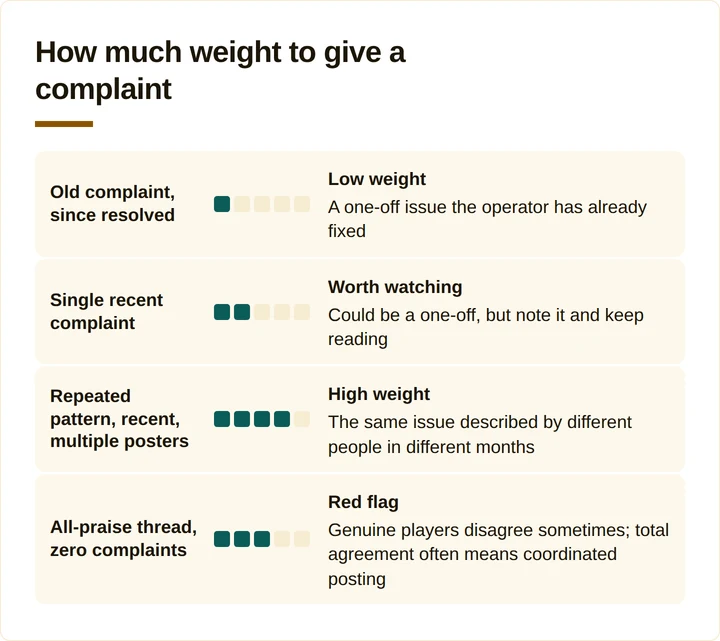
A single angry post is not a reliable reputation verdict. It could be a one-off support failure, a misunderstanding of terms, or user error. I’ve read threads where the “scam” turned out to be a player who didn’t meet a wagering requirement they’d skimmed past. The fault lay with the player, who had skipped the fine print.
A repeated pattern across multiple posters over time signals a systemic problem. If different people, in different months, describe the same complaint, whether slow withdrawals, unresponsive support, or bonuses that never credit, that’s a signal worth heeding. The repetition is what separates an anomaly from a flaw in how the place operates.
The mirror image is just as telling. An all-praise thread with no complaints at all is itself a red flag for astroturfing or fake engagement. Real communities have friction. Real players complain when things go wrong. A thread where every single post reads like a testimonial usually means someone is paying for those words.
If you see five new accounts posting identical praise for the same casino in the same week, that pattern itself is the red flag. Genuine players don’t coordinate their enthusiasm that way. They disagree, they ask follow-up questions, and they push back when something sounds too good. The absence of that natural friction is what should make you suspicious.
Our moderation and trust guide covers active moderation, a healthy mix of praise and complaints, and referral-spam rules in full. This article focuses on using that talk for reputation checks.
Where This Talk Actually Happens
Forum discussion about casinos happens in a variety of online spaces, each with its own character and its own blind spots. Our sibling post on player communities and forums covers where this discussion lives in detail. The most useful reputation signals often come from the less polished corners where people aren’t trying to sell you anything.
Each venue has its own incentives. Some sites are funded by affiliate commissions, which means the people running them earn money when you click through and sign up at a casino they recommend. That doesn’t automatically make their reviews worthless, but it does mean you should read them with an awareness of where the money flows. Player-run communities without affiliate relationships have fewer reasons to steer you toward one operator over another, which is why their complaint threads and payout reports often carry more weight.
What This Means Before You Play
You can put this into practice before signing up somewhere new.
Check forum sentiment first, and weigh recency alongside volume.
Start with a simple search. Find the casino’s name plus words like “withdrawal,” “complaint,” or “scam.” Read what comes up. Then search for the name plus “payout” or “won” to see the positive side. You’re building a picture, and looking for a single verdict will only mislead you.
Recency matters more than most people realise. An old complaint about an issue the operator has since fixed, such as a withdrawal-processing bug from three years ago, doesn’t carry the same weight as a similar complaint from last month. Operators change, software gets updated, support teams get replaced. When you’re checking reputation, ask when the complaints happened, and whether they still reflect the current operation.
I check three things before I play anywhere new. Whether recent withdrawal complaints exist. Whether the operator responds to criticism publicly. Whether the praise sounds like real people or marketing copy. That takes about fifteen minutes and has saved me from at least a few bad experiences.
When you read heated threads about people chasing losses, remember that forum anger often comes from players who stayed too long at a losing table. That’s a human response, and it carries no weight as a casino reputation signal. If you recognise that pattern in yourself, our playing within your limits page has practical advice worth reading before your next session.
It also helps to develop a sense of how long a casino has been operating and whether the complaints you find cluster around a particular period. A burst of complaints from a single month might reflect a technical outage or a change in terms that affected everyone at once. Complaints spread evenly across two years suggest a steady pattern of behaviour. Both are worth noting, but they point to different conclusions about the operator.
Another habit that serves players well is checking whether the same complaint appears across multiple venues. A slow-payout issue mentioned only on one small forum could be an isolated grudge. The same issue described on several independent sites, by different usernames, with different dates and different amounts, is much harder to dismiss. Checking across different places is one of the simplest ways to separate genuine patterns from coordinated noise.
Conclusion
Forum talk is the closest thing players have to an independent audit of a casino. It’s messy, sometimes unfair, occasionally astroturfed. But over time, patterns emerge that marketing copy can’t hide. Reading those patterns before you play is a small act of care for yourself.
And that’s the kapwa spirit at work. When we share what we’ve experienced, whether the slow payout, the helpful support agent, or the bonus that actually credited, we’re looking out for each other. One player’s warning saves another from the same frustration. One player’s praise points someone toward a place that treats people decently.
Before your next deposit, spend fifteen minutes reading what other players have said. Their words are a gift, offered freely. Take it.
FAQ
How quickly can forum talk change a casino’s reputation? Fast, when the pattern is clear. A cluster of recent, similar complaints can shift perception within weeks, especially if the operator stays silent. Conversely, a visible fix, such as a public apology or a resolved dispute thread, can rebuild trust over a few months.
Is one bad review enough to avoid a casino? No. One bad review can be a one-off failure or a misunderstanding. Wait until you see the same complaint repeated by different posters over time before treating it as a pattern.
What does an all-praise thread usually mean? It’s a red flag. Real communities include complaints. A thread with zero criticism often indicates astroturfing or fake engagement.
Should I trust recent complaints more than old ones? Yes. Operators change and issues get fixed. A complaint from last month matters more than a similar one from three years ago, especially if the older issue appears resolved.
Where should I look for genuine player talk? The sibling post on player communities and forums lists the main venues. In general, look for places where players aren’t being paid to post and where moderation allows both praise and criticism.
How do I know if a community itself is trustworthy? That’s a separate question from a casino’s reputation. The moderation and trust guide on this site explains those signals in full.